by fljustice | Mar 12, 2011 | Biographies, Books, Hypatia, Reviews, Wonderful Women
Hypatia of Alexandria: Two Books
It’s March—Women’s History Month and the anniversary of a remarkable woman’s death. In AD 415, a Christian mob murdered Hypatia, the renowned Lady Philosopher of Alexandria. The vicious act shocked the city and shamed the early Church. Socrates Scholasticus tells the story in his Historia Ecclesiastica:
“Hypatia, daughter of the philosopher Theon, who made such attainments in literature and science, as to far surpass all the philosophers of her own time…For all men on account of her extraordinary dignity and virtue admired her the more. Yet even she fell a victim to the political jealousy which at that time prevailed. For as she had frequent interviews with Orestes, it was calumniously reported among the Christian populace, that it was she who prevented Orestes from being reconciled to the bishop. Some of them therefore, hurried away by a fierce and bigoted zeal, whose ringleader was a reader named Peter, waylaid her returning home, and dragging her from her carriage, they took her to the church called Caesareum, where they completely stripped her, and then murdered her with tiles. After tearing her body in pieces, they took her mangled limbs to a place called Cinaron, and there burnt them. This affair brought not the least opprobrium, not only upon Cyril, but also upon the whole Alexandrian church. And surely nothing can be farther from the spirit of Christianity than the allowance of massacres, fights, and transactions of that sort. This happened in the month of March during Lent, in the fourth year of Cyril’s episcopate, under the tenth consulate of Honorius, and the sixth of Theodosius.”
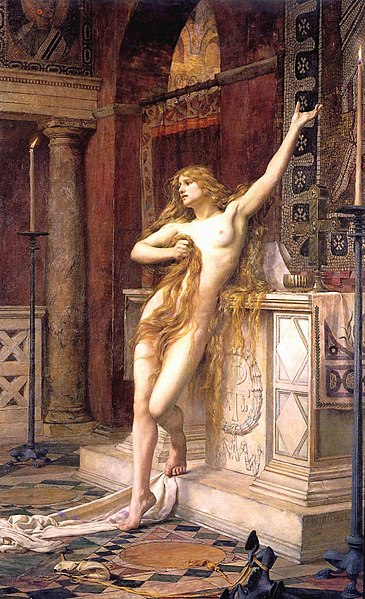
Hypatia, painted by Charles William Mitchell in 1885.
Since that time, only fragments about Hypatia’s life have come down to us; allowing poets, novelists, playwrights, scientists, feminists and religionists (both pro and anti) to appropriate her story for themselves. Her story has resonated down through the years, touching many people. She’s a major character in my novel Selene of Alexandria, the subject of the recent movie Agora directed by Alejandro Amenabar, and she rated a plate in Judy Chicago’s massive art piece The Dinner Party. She’s the subject of plays, poetry, propaganda and new age pagan polemics. Her life is represented in art and music. But what do we really know about her? Not much.
In researching my novel, I waded through a literary swamp, with no guide, trying to get at some coherent view of Hypatia and her story. She was young/middle aged/older when she died. She was single/married/promiscuous/virginal. She was a pagan/witch/Christian. She was a brilliant mathematician/scientist to some and, according to others, contributed nothing worthwhile in either discipline. I read the few primary sources, but didn’t have the academic background to evaluate their usefulness. Socrates was a contemporary, but a church historian. Damascius was a pagan who wrote a full generation later. John of Nikiu wrote 200 years later. Who had an agenda and what was it?
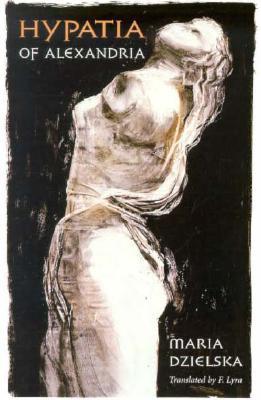
Two scholars have attempted to pull the pieces together in book form in the last two decades: Maria Dzielska, a Polish classics scholar, with Hypatia of Alexandria; and mathematics professor Michael A. B. Deakin with Hypatia of Alexandria: Mathematician and Martyr. I’ve read both, several times, in my research and want to share my thoughts. (more…)
by fljustice | Jan 28, 2011 | Biographies, Books, Reviews, Wonderful Women
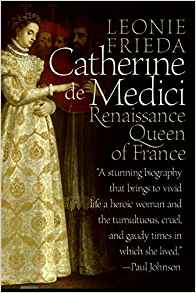
“Catherine de Medici: Renaissance Queen of France” by Leonie Frieda
Long, long ago in a youth far, far away, I read a biography of Catherine de Medici, so I was already familiar with her story. I have to admit, the details were hazy: I remembered something about poison, religious wars and that she was Mary, Queen of Scots’ mother-in-law. Then a couple of years ago, my husband and I took a biking vacation in the Loire valley and visited numerous castles and gardens along way, several associated with Catherine and her rival Diane de Poitiers; so I was reacquainted with the general outlines of her story. Which brings me to: Catherine de Medici: Renaissance Queen of France by Leonie Frieda.
From the Introduction:
“Catherine de Medici has variously been called ‘The Maggot from Italy’s Tomb’, ‘The Black Queen’ and ‘Madame La Serpente’. To many she is the very incarnation of evil. It is, I believe, as mistaken a judgment as it is bigoted. Yet it is not far removed from the overall verdict of history on one of the most remarkable women of the sixteenth century.” (more…)
by fljustice | Jan 21, 2011 | History, History in the News
History in the News:
Cleopatra’s Needle, New Human Cousins and Bog Bodies
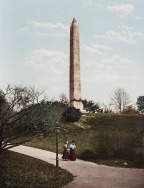
Cleopatra’s Needle, 1901
One of the delights of living in NYC is Central Park. It’s not only a green space and refuge for weary urbanites, it’s the site of many monuments; some are gifts from other countries. One of the most magnificent is the 3,500-year-old granite obelisk commemorating King Thutmose III, commonly known as Cleopatra’s Needle, situated on a rise in back of the Metropolitan Museum of Art. This ancient artifact is one of a pair originally situated in Heliopolis, Egypt. The Romans moved them in 12 B.C. to adorn a temple in Alexandria. In 1877, the Khedive of Egypt gave one of the obelisks to the US. It was erected in Central Park in 1881 after an epic two and half year journey. It has sat in the New York climate ever since. Zahi Hawass, the secretary general of Egypt’s Supreme Council of Antiquities, recently posted on his blog a letter he sent to the Central Park Conservancy and Mayor Bloomberg, complaining about lack of proper care for the monument. He said, “I will take the necessary steps to bring this precious artifact home and save it from ruin.” The hieroglyphics are significantly eroded and many people believe the weathering occurred during the last century. The Conservancy denies that the monument has been neglected. This blog post uses photos to show the obelisk was already in poor shape when it arrived. Dr. Hawass is probably in error about when the erosion happened, but his complaint may spur the city and the Conservancy to make sure it doesn’t deteriorate further. I’ll update this post if the controversy continues. (Link to original article.) (more…)
by Faith Justice | Aug 18, 2010 | History, History in the News
History in the News:
Pyroclastic Clouds, Dead Dogs, and Ads on the Coliseum
As I’ve said on my About page, I’m a history junkie and science geek. I love the intersection of these two disciplines: DNA markers that trace humankind’s exodus from Africa, isotope analysis of teeth and bones that tell us where and when ancient people grew up and what they ate, UV light to fluoresce bones and fingerprints on artifacts, and much more. Over half of my “history in the news” stories this round up have a major science component–from what really killed people in Pompeii to discovering a “lost” Roman city from aerial photographs to where the Dead Sea Scrolls were manufactured. You can click on the links to see the original stories. We’ll start with Pompeii.
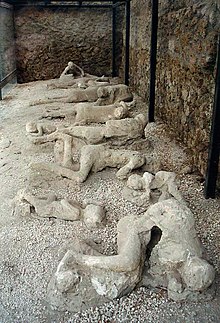 Most historians and archaeologists believed the people at Pompeii, who where not killed by spewing rocks, died of suffocation from ash and poisonous gas. Pliny the Younger described the process in letters written 25 years later. Giuseppe Mastrolorenzo, a vulcanologist from the Naples Observatory claims “Everything that has been written in the guides, and the texts, and that has been re-told to tourists [about how people died at Pompeii] is false.” He spent years analyzing skeletal casts, testing bone tissue and simulating Vesuvius eruptions. He published his findings in the science journal PLoS One. Mastrolorenzo concludes that the people of Pompeii were instantly killed by a pyroclastic cloud, a surge of super-heated air. He also proved these high temperatures can be carried up to 12 miles away from the volcano. The Italian Civil Protection requires only those people living five miles from Vesuvius to evacuate, which puts 3 million people in and around Naples in harm’s way, in case of another eruption.
(more…)
by Faith Justice | Jul 18, 2010 | History, History in the News
History in the News:
Bones, Poison, and Treasure
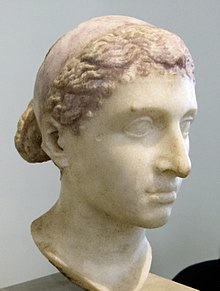
Bust of Cleopatra VII in Berlin
I’ll be doing a regular round up of archaeology and history stories that make it into the mainstream press every couple of weeks with links to the original stories. The focus will be on Roman history, but anything that catches my fancy will be fair game. This post features several finds in Britain including a hoard of coins, a controversial skeleton initially thought to be a female gladiator, and the graves of 97 infants; Roman frescoes, canals and looted artifacts; and renewed speculation over Cleopatra’s death. Snakebite or poison?
I don’t know if it’s because the stories are printed in English, Britain has an abundance of archaeologists and amateur treasure hunters, or some other fluke of randomness, but fully half the stories that caught my attention this round up are from Britain. We’ll start with the bones and end with the treasure.
In Caistor (from the Anglo-Saxon ceaster meaning Roman camp or town), archaeologists have discovered a large, well-organized late Roman cemetery. They’ve recovered 46 sets of human remains from the site of the derelict Talbot Inn which is being redeveloped into a Lincolnshire cooperative food store. The remains – including complete skeletons – will be studied and reburied. Colin Palmer-Brown, Director of the Pre-Construction Archaeological Services Ltd team overseeing the site believes there are “hundreds if not thousands of people buried in this part of Caistor.”
(more…)
by Faith Justice | Jun 25, 2010 | Essays/Research, Writing
Historical Research Using Internet, Interviews and Site Visits
 In Part I of this two-part series, I talked about using books and libraries in doing historical research. Although print matter is a good place to start, in today’s world you can’t ignore the Internet. But there are two problems: quantity and quality – too much of the former and not enough of the latter. Unlike traditionally published books, which have to go through some screening process (in academic circles that can be quite rigorous), anyone can put anything up on the Net and pass it off as truth. So what’s a good historical fiction writer to do?
Stick to sites that have some stake in maintaining their reputation for accuracy such as universities and historical, archaeological and professional societies. Many sites not only update articles, but blog and tweet as well. Others aggregate the news. The Archaeological Institute of America has a daily update of archaeology in the news. When you find interesting aggregators, subscribe to their RSS feed, get email alerts or tweets when new information is posted. Google also has Google Scholar (click on the “more” button at the Google.com home page) that searches professional and scholarly literature. Many newspapers and local government organizations have digitized their archives and can be a great source of primary material. (Remember your best friend the research librarian? Tap them for help on accessing those databases.)
(more…)